

South Bridge project has skipped 1041 application
Garfield County letter asks City of Glenwood Springs to follow through on process
PRESS RELEASE
March 18, 2026
Garfield County is formally requesting that the City of Glenwood Springs file a 1041 regulations application with the county for the proposed South Bridge project. A county letter to the City of Glenwood Springs will state that if the city continues its refusal to file the 1041 application, the county will file for an injunction.
Garfield County Attorney Heather Beattie said that while the City of Glenwood Springs presented the project to the Board of County Commissioners in October 2025, it has not yet filed the 1041 application.
“In that refusal, they are essentially disagreeing with some of the language in our land use and development code,” she said. “Essentially, the county hasn’t really been part of any of the South Bridge project since at least 2020.”
Enacted in 1974, Colorado House Bill 1041 “gives local governments additional authority for planning decisions related to areas or activities of statewide concern” allowing “communities to identify, designate, and regulate those activities and areas through a local permitting process,” according to the State of Colorado’s Planning for Hazards 1041 regulations web page.
The bridge proposal includes a portion of Airport Road in the City of Glenwood Springs and crosses a stretch of the Roaring Fork River and the Jackson Ranch, both of which are in Garfield County, before connecting with Highway 82 south of the city on a Colorado Department of Transportation (CDOT) right of way near Holy Cross Energy.
“The most expensive part of the project will likely be the bridge crossing the Roaring Fork River and that’s in unincorporated Garfield County,” said Commissioner Tom Jankovsky. “This is really about the procedure in our land-use code and not a motion for or against the project.”
Garfield County Community Development Director Glenn Hartmann told the board that a 1041 has three basic levels of potential review: a finding of no significant impact; a minor process for smaller scale projects; and a major review process that triggers several different criteria for being a significant endeavor.
“The differences are that a major project goes to the Garfield County Planning Commission and the Board of County Commissioners. The minor one goes just to this board, and the finding of no significant impact is a determination at the staff level,” he explained. “For public projects, there’s also a location and extent review, which is to determine consistency with the county’s comprehensive plan, and that is heard by the planning commission.”
Hartmann also noted that a floodplain development permit process could be needed depending on the bridge design since the project crosses the Roaring Fork River.
“We need more information to determine the applicability of that process,” he said. “If there are impacts or improvements within the 100-year floodplain on the Roaring Fork River, then we would require that permitting. For a project like this, it would be mostly mitigation, demonstration that there are no impacts in terms of flood elevation, and restoration and reclamation, all of which are typical for that type of review.”
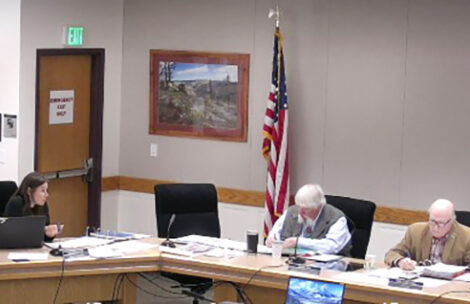
The board unanimously directed the Garfield County Attorney’s Office to write a letter for the board to review and approve prior to sending it to the City of Glenwood Springs.